One Man, One Dream, Big Change
Presently, Martin Luther King Jr. is well known for being one of the most important voices in the fight for civil rights in the United States. However, at the time of him being alive, his presence meant very little, and during his efforts, he only received hate from the public.
Born in 1962, Martin Luther King Jr. was born in Atlanta, Georgia, during a very difficult time in the United States. Segregation was at its peak, in which black and white individuals were separated whenever possible, such as in schools, buses, restaurants, and so on. As a youthful individual, King noticed that this discrimination was leading to no good and that it would only prove to be hurtful and unfair.
King was never a fan of violence and advocated for methods such as boycotts, speeches, and marches in order to bring attention to issues and allow for justice. He was very inspired by the idea of Gandhi, where powerful protests bring more light and are more powerful compared to violence. This was what made him stand out during those difficult times — achieving peace and allowing his voice to be heard through methods that did not provide harm to harmless bystanders.
One of his most memorable moments was during the Montgomery Bus Boycott in 1955, following the arrest of Rosa Parks after she refused to give up her seat for a white passenger on the bus. This led to King organizing a city-wide boycott on buses, which ended up being successful after a year; segregation on buses was eventually ruled unconstitutional.
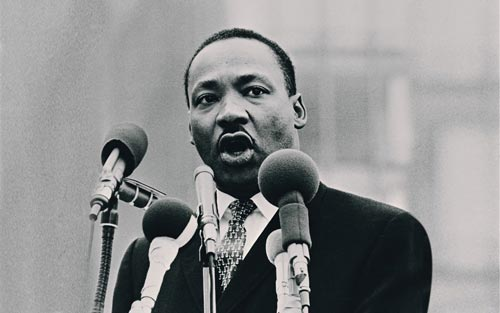
Later on in his life, he became the leader of the Southern Christian Leadership Conference (SCLC), where he helped to organize boycotts across the city. He eventually gave his infamous “I Have A Dream” speech in March 1963 in Washington, where he spoke of his dream where in the future, people would be judged by character—not skin color. Even now, millions of people still talk about that speech.
Unfortunately, King was assassinated in 1968, four short years after winning the Nobel Peace Prize for his work in 1964. However, his presence still remains in this world; his message remains in the hearts of many civilians, and he is remembered as a symbol of courage, equality, and the power of peaceful change.